chemistry what was the equivalence point (ml of c6h8o7 needed to reach the end point)
Learning Objectives
- Define equivalence point.
- Describe how to perform a titration experiment.
- Perform calculations to determine concentration of unknown acid or base.
- Describe titration curves of acrid-base neutralization reactions.
Titration Experiment
Didn't that used to be French chips?
A lot of research is going on these days involving the development of biodiesel fuels. Oft this fabric tin can be made from used vegetable oils. The vegetable oil is treated with lye to create the biofuel. In the oils is a variable amount of acid that needs to be determined so the workers will know how much lye to add to brand the final fuel. Earlier the lye is added, the native vegetable oil is titrated to find out how much free acid is present. And so the corporeality of lye added can be adapted to take into account the amount needed to neutralize these free acids.
In the neutralization of muriatic acid by sodium hydroxide, the mole ratio of acid to base is 1:1.

One mole of HCl would be fully neutralized by one mole of NaOH. If instead the hydrochloric acid was reacted with barium hydroxide, the mole ratio would exist two:1.

Now two moles of HCl would be required to neutralize one mole of Ba(OH) 2 . The mole ratio insures that the number of moles of H + ions supplied by the acrid is equal to the number of OH − ions supplied past the base. This must exist the example for neutralization to occur. The equivalence point is the bespeak in a neutralization reaction where the number of moles of hydrogen ions is equal to the number of moles of hydroxide ions.
In the laboratory, it is useful to have an experiment where the unknown concentration of an acrid or a base can be determined. This tin can exist accomplished by performing a controlled neutralization reaction. A titration is an experiment where a volume of a solution of known concentration is added to a volume of another solution in club to make up one's mind its concentration. Many titrations are acrid-base neutralization reactions, though other types of titrations can also be performed.
In order to perform an acrid-base of operations titration, the chemist must have a way to visually detect that the neutralization reaction has occurred. An indicator is a substance that has a distinctly different color when in an acidic or bones solution. A commonly used indicator for strong acrid-stiff base titrations is phenolphthalein. Solutions in which a few drops of phenolphthalein have been added plow from colorless to brilliant pinkish as the solution turns from acidic to bones. The steps in a titration reaction are outlined below.
- A measured volume of an acid of unknown concentration is added to an Erlenmeyer flask.
- Several drops of an indicator are added to the acid and mixed by swirling the flask.
- A buret is filled with the base solution of known molarity.
- The stopcock of the buret is opened and base is slowly added to the acid while the flask is constantly swirled to insure mixing. The stopcock is closed at the exact point at which the indicator but changes color.
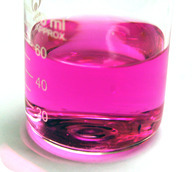
Effigy 1. Phenolphthalein in basic solution.
The standard solution is the solution in a titration whose concentration is known. In the titration described above the base solution is the standard solution. Information technology is very important in a titration to add the solution from the buret slowly so that the point at which the indicator changes color can exist institute accurately.
The end point of a titration is the point at which the indicator changes colour. When phenolphthalein is the indicator, the finish point will be signified by a faint pink color.
Titration Calculations
How is lather made?

The manufacture of soap requires a number of chemistry techniques. One necessary piece of data is the saponification number. This is the amount of base of operations needed to hydrolyze a sure amount of fatty to produce the free fatty acids that are an essential part of the final product.
The fat is heated with a known corporeality of base (normally NaOH or KOH). After hydrolysis is consummate, the left-over base is titrated to determine how much was needed to hydrolyze the fat sample.
Titration Calculations
At the equivalence point in a neutralization, the moles of acid are equal to the moles of base.
moles acid = moles base
Call back that the molarity (Chiliad) of a solution is defined as the moles of the solute divided by the liters of solution (50). So the moles of solute are therefore equal to the molarity of a solution multiplied by the volume in liters.

Nosotros tin then set the moles of acid equal to the moles of base of operations.

 is the molarity of the acid, while
  is the molarity of the base.
  and
and  are the volumes of the acrid and base, respectively.
Suppose that a titration is performed and xx.lxx mL of 0.500 M NaOH is required to achieve the end point when titrated against xv.00 mL of HCl of unknown concentration. The higher up equation can be used to solve for the molarity of the acid.

The higher molarity of the acid compared to the base in this instance ways that a smaller volume of the acrid is required to reach the equivalence point.
The above equation works only for neutralizations in which there is a 1:1 ratio between the acid and the base. The sample problem below demonstrates the technique to solve a titration trouble for a titration of sulfuric acid with sodium hydroxide.
Sample Problem: Titration
In a titration of sulfuric acid against sodium hydroxide, 32.20 mL of 0.250 M NaOH is required to neutralize 26.60 mL of H2So4. Calculate the molarity of the sulfuric acrid.
Step 1: List the known values and plan the problem.
Known
- molarity NaOH = 0.250 Grand
- volume NaOH = 32.xx mL
- volume H two SO 4 = 26.60 mL
Unkonwn
- molarity H ii And then iv = ?

First decide the moles of NaOH in the reaction. From the mole ratio, summate the moles of H two SO 4 that reacted. Finally, divide the moles H 2 SO iv past its book to get the molarity.
Footstep two: Solve.
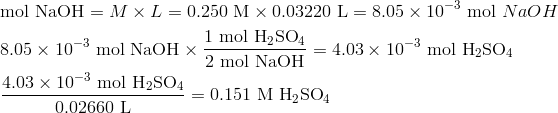
Step 3: Think about your issue.
The volume of H2And so4 required is smaller than the volume of NaOH because of the two hydrogen ions contributed by each molecule.
Titration Curves
Where did graphs come from?
The x–y plot that we know of as a graph was the brainchild of the French mathematician-philosopher Rene Descartes (1596–1650). His studies in mathematics led him to develop what was known every bit "Cartesian geometry," including the idea of our electric current graphs. The coordinates are often referred to as Cartesian coordinates.

Titration Curves
As base is added to acrid at the beginning of a titration, the pH rises very slowly. Nearer to the equivalence indicate, the pH begins to rapidly increase. If the titration is a strong acid with a stiff base, the pH at the equivalence bespeak is equal to vii. A bit by the equivalence point, the rate of change of the pH once again slows downwardly. A titration curve is a graphical representation of the pH of a solution during a titration. The Figure beneath shows two dissimilar examples of a strong acid-potent base titration curve. On the left is a titration in which the base is added to the acid and so the pH progresses from depression to high. On the right is a titration in which the acid is added to the base. In this case, the pH starts out high and decreases during the titration. In both cases, the equivalence point is reached when the moles of acid and base are equal and the pH is 7. This also corresponds to the color change of the indicator.
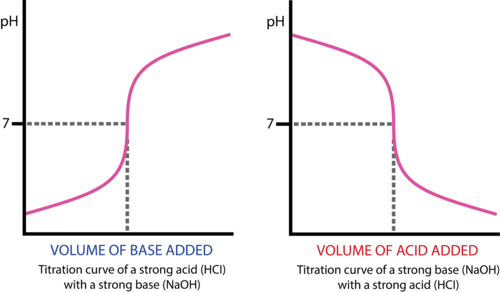
Effigy two. A titration curve shows the pH changes that occur during the titration of an acid with a base. On the left, base is beingness added to acid. On the right, acid is being added to base. In both cases, the equivalence point is at pH seven.
Titration curves can also be generated in the case of a weak acrid-strong base of operations titration or a strong base of operations-weak acid titration. The general shape of the titration curve is the same, but the pH at the equivalence point is different. In a weak acid-strong base of operations titration, the pH is greater than seven at the equivalence point. In a stiff acid-weak base titration, the pH is less than 7 at the equivalence point.
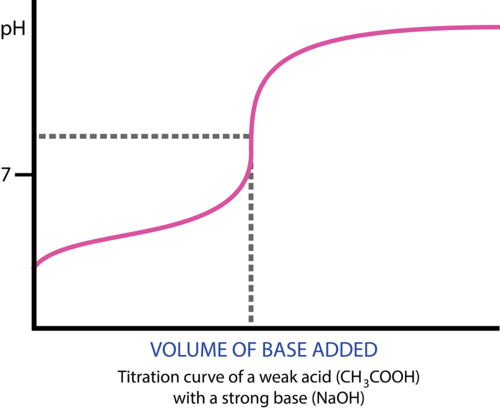
Figure iii. Titration bend of weak acid and potent base.
Summary
- Definitions are given for equivalence point, titration and indicator.
- The process for carrying out a titration is described.
- The process of calculating concentration from titration data is described and illustrated.
- Acid-base titration curves are described.
Practice
Titration Experiment
Lookout man the video at the link below and reply the following questions:
- What is the indicator used?
- What color is it in acid solution?
- What is the glass tube called that contains the known concentration of sodium hydroxide?
- What other method can exist used to decide the finish-point of the titration?
Titration Calculations
Do the problems at the link below:
http://www.sophia.org/acidbase-titration-calculations-concept
Titration Curves
Read the fabric at the link below and answer the post-obit questions:
http://world wide web.chemguide.co.united kingdom/physical/acidbaseeqia/phcurves.html
- Why is the equivalence point less than pH 7 for the titration of ammonia with HCl?
- Why is it hard to do a titration of a weak acid and a weak base?
- Why do we become two inflection points for the titration of ethanedioic acid?
Review
Titration Experiment
- What is the standard solution?
- How do yous know you have reached the cease-signal?
- What is the reaction that occurs during a titration?
Titration Calculations
- What supposition is made nearly the amounts of materials at the neutral indicate?
- What is different near the adding using sulfuric acrid?
- Why is the mole ratio important?
Titration Curves
- What does a titration bend tell united states of america?
- At what pH are the moles of acrid and base equal?
- Is the equivalence signal for a weak acrid-potent base titration the same equally for a strong-acid-strong base of operations titration?
Glossary
- end point: The point at which the indicator changes color.
- equivalence point: The point in a neutralization reaction where the number of moles of hydrogen ions is equal to the number of moles of hydroxide ions.
- indicator: A substance that has a distinctly different color when in an acidic or basic solution.
- standard solution: The solution in a titration whose concentration is known.
- titration: An experiment where a book of a solution of known concentration is added to a book of some other solution in club to determine its concentration.
- titration curve: A graphical representation of the pH of a solution during a titration.
Source: https://courses.lumenlearning.com/cheminter/chapter/titration/
0 Response to "chemistry what was the equivalence point (ml of c6h8o7 needed to reach the end point)"
Post a Comment